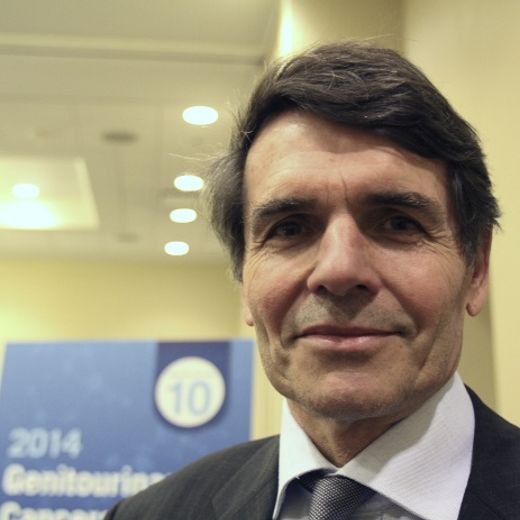
SAN FRANCISCO— Plasma and tumor biomarkers including FGF, C-KIT and VEG-F were found to yield prognostic information which could help guide therapies, according to research findings presented at the 2
SAN FRANCISCO— Plasma and tumor biomarkers including FGF, C-KIT and VEG-F were found to yield prognostic information which could help guide therapies, according to research findings presented at the 2014 ASCO Genitourinary Cancers Conference. Professor Bernard Escudier MD from the Institut Gustave Roussy in Villejuif near Paris discussed results from a biomarker analysis of the multinational phase III randomized GOLD study looking at “third-line” therapy for metastatic renal cell carcinoma with the FGF-directed agent dovitinib compared with sorafenib in patients with metastatic renal cell carcinoma after one prior VEGF pathway–targeted therapy and one prior mTOR inhibitor therapy. High baseline cKIT and low baseline FGF2, HGF, PlGF, sVEGFR1, VEGFA, and VEGFD were associated with better overall survival in patients treated with either sorafenib or dovitinib, and the analysis concluded that baseline plasma biomarkers are prognostic but not predictive in the third-line setting.
CONTACT:
Professor Bernard Escudier MD
Medical Oncologist
Institut Gustave Roussy, France
Unité D’immunology
39 rue Camille-Desmoulins
94805 Villejuif Cedex
France
SOURCE:
Abstract number: 473, ASCO 2014 Genitourinary Cancers Symposium, San Francisco
Author(s):
Bernard J. Escudier, Camillo Porta, Matthew Squires, Cezary Szczylik, Christian K. Kollmannsberger, Bohuslav Melichar, Sun Young Rha, Emilio Esteban, Georg A. Bjarnason, Nicholas J. Vogelzang, Cora N. Sternberg, Michael Shi, Mathab Marker, Robert John Motzer; Institut Gustave Roussy, Villejuif, France; IRCCS San Matteo University Hospital Foundation, Pavia, Italy; Novartis Pharma AG, Basel, Switzerland; Military Institute of Health Services in Warsaw, Warsaw, Poland; BCCA Vancouver Cancer Centre, Vancouver, BC, Canada; Palacky University Medical School and Teaching Hospital, Olomouc, Czech Republic; Yonsei University College of Medicine, Seoul, South Korea; Hospital Universitario Central de Asturias, Oviedo, Spain; Sunnybrook Odette Cancer Centre, Toronto, ON, Canada; Comprehensive Cancer Centers of Nevada, Las Vegas, NV; San Camillo and Forlanini Hospital, Rome, Italy; Novartis Pharmaceuticals Corporation, East Hanover, NJ; Memorial Sloan-Kettering Cancer Center, New York, NY
LINK:
Web link: http://meetinglibrary.asco.org/content/123462-142
Tags
Related Episodes
Active Surveillance Better for Which Renal Cell Cancers?
April 15, 2017 Active Surveillance for Renal Cell Cancer MILAN, Italy—Criteria for withholding aggressive therapies early in the course of renal cell cancer were updated at the 2016 European Mu

David R Spigel MD; ASCO 2026: Bispecific PD-1/VEGF Antibody Ivonescimab Extends Life in Patients with Untreated Advanced Non–Small Cell Lung Cancer: Phase 3 HARMONi-6 trial
CHICAGO, USA—The bispecific antibody ivonescimab (that targets the PD-1 and VEGF molecules) has extended overall survival in patients with untreated advanced squamous non-small cell lung cancer in the latest data from the HARMONi-6 trial reported at the 2026 Annual Meeting of the American Society of Clinical Oncology by Chen Zhiwei from Jiao Tong University in Shanghai, China. Peter Goodwin discusses the findings with ASCO expert David R Spigel MD, President & Chief Medical Officer at the Sarah Cannon Research Institute in Nashville, Tennessee, USA

Vanita Noronha MD; ASCO 2026: Ultra-Low Dose Immunotherapy Extends Life with Metastatic Head and Neck Cancer at Low Cost for Patients in Low and Middle Income Countries
CHICAGO, USA—Although recurrent or metastatic head and neck cancers respond well to palliative chemotherapy with immune checkpoint inhibition, this approach may be un-affordable in low and middle income countries. But a randomized phase three trial from India reported a pragmatic solution at the 2026 Annual Meeting of the American Society of Clinical Oncology. Ultra-low doses of pembrolizumab immunotherapy along with “triple oral metronomic chemotherapy” were found to bring good palliation and longer survival according to Vanita Noronha MD, Professor of Medical Oncology, Tata Memorial Hospital, Mumbai, India, as she explained to Peter Goodwin.