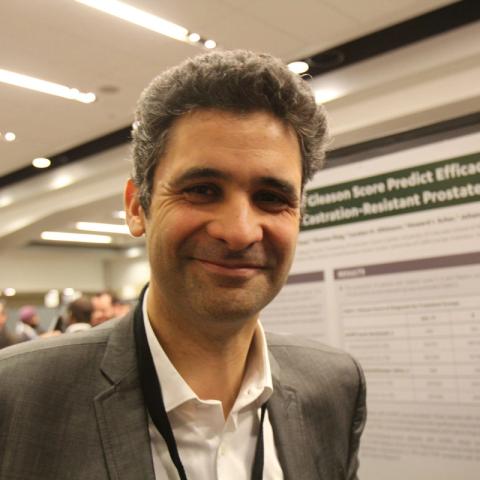
Initial Gleason score does not predict abiraterone response in patients with metastatic castration-resistant prostate cancer
SAN FRANCISCO— Gleason score at initial diagnosis was not predictive of response to abiraterone in patients with metastatic castration-resistant prostate cancer in a pooled analysis of three trials of

SAN FRANCISCO— Gleason score at initial diagnosis was not predictive of response to abiraterone in patients with metastatic castration-resistant prostate cancer in a pooled analysis of three trials of abiraterone acetate therapy presented at the 2014 ASCO Genitourinary Cancers Symposium. Karim Fizazi MD PhD, Professor of Medicine and Head of the Department of Cancer Medicine at the Institut Gustave Roussy in Villejuif, Paris, discussed his group’s findings and the implications for using new generation androgen deprivation therapy in the advanced stages of prostate cancer.
CONTACT:
Dr. Karim Fizazi MD PhD
Head of the Department of Cancer Medicine
Institut Gustave Roussy, Villejuif, Paris
SOURCE:
Does Gleason score (GS) predict efficacy of abiraterone acetate (AA) therapy in patients (pts) with metastatic castration-resistant prostate cancer (mCRPC)? An analysis of AA phase 3 trials.
LINK:
Web link: http://meetinglibrary.asco.org/content/123754-142
TAGS:
Gleason score, abiraterone, metastatic castration-resistant prostate cancer, ASCO GU 2014 Symposium San Francisco, anti-androgen therapy, androgen deprivation,
Tags
Next in ASCO 2014
All 7 interviewsInterview 5 of 7

Responses to enzalutamide after prior abiraterone therapy in men with castration-resistant metastatic prostate cancer
SAN FRANCISCO— Four out of ten patients whose metastatic castration resistant prostate cancer had already been treated with abiraterone responded to further ‘new generation’ androgen depri
Related Episodes

Orteronel shows no survival advantage in metastatic castration-resistant prostate cancer: phase III randomized study finds
SAN FRANCISCO—Orteronel — a non-steroidal selective inhibitor of 17,20-lyase — did not achieve a significant improvement in overall survival in 1099 patients randomised to treatment with this “a

David R Spigel MD; ASCO 2026: Bispecific PD-1/VEGF Antibody Ivonescimab Extends Life in Patients with Untreated Advanced Non–Small Cell Lung Cancer: Phase 3 HARMONi-6 trial
CHICAGO, USA—The bispecific antibody ivonescimab (that targets the PD-1 and VEGF molecules) has extended overall survival in patients with untreated advanced squamous non-small cell lung cancer in the latest data from the HARMONi-6 trial reported at the 2026 Annual Meeting of the American Society of Clinical Oncology by Chen Zhiwei from Jiao Tong University in Shanghai, China. Peter Goodwin discusses the findings with ASCO expert David R Spigel MD, President & Chief Medical Officer at the Sarah Cannon Research Institute in Nashville, Tennessee, USA

Vanita Noronha MD; ASCO 2026: Ultra-Low Dose Immunotherapy Extends Life with Metastatic Head and Neck Cancer at Low Cost for Patients in Low and Middle Income Countries
CHICAGO, USA—Although recurrent or metastatic head and neck cancers respond well to palliative chemotherapy with immune checkpoint inhibition, this approach may be un-affordable in low and middle income countries. But a randomized phase three trial from India reported a pragmatic solution at the 2026 Annual Meeting of the American Society of Clinical Oncology. Ultra-low doses of pembrolizumab immunotherapy along with “triple oral metronomic chemotherapy” were found to bring good palliation and longer survival according to Vanita Noronha MD, Professor of Medical Oncology, Tata Memorial Hospital, Mumbai, India, as she explained to Peter Goodwin.