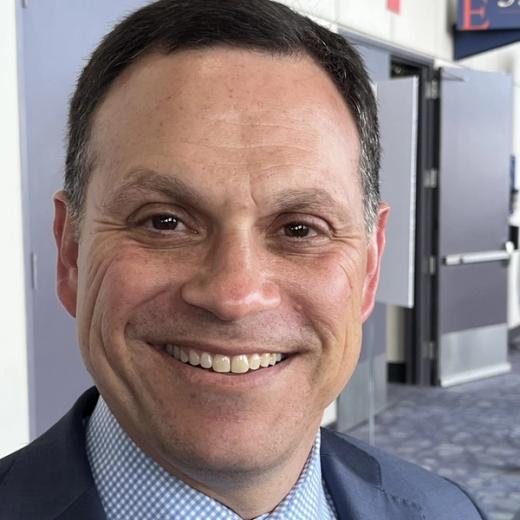
An interview with: David R Spigel FASCO, MD, Chief Scientific Officer, Sarah Cannon Research Institute, Nashville, Tennessee, US With comment from: Luis G Paz-Ares MD PhD Chair of Medical Oncology, Ho
An interview with:
David R Spigel FASCO, MD, Chief Scientific Officer, Sarah Cannon Research Institute, Nashville, Tennessee, US
With comment from:
Luis G Paz-Ares MD PhD
Chair of Medical Oncology, Hospital Universitario 12 de Octubre, Universitario de Madrid
CHICAGO, USA—Although patients with early non-squamous non-small cell lung cancer can be cured by surgery alone, many are not. So, researchers in Nashville USA set up an international, multi-center, prospective randomized a study to examine whether a gene molecular assay could help by identifying patients at higher risk and treating them with adjuvant chemotherapy. Improved outcomes were reported at the 2025 Annual Meeting of the American Society of Clinical Oncology.
After his ASCO talk the study leader, David Spigel MD, Chief Scientific Officer at the Sarah Cannon Research institute in Nashville, gave the details to Audio Journal Oncology reporter Peter Goodwin.
ASCO 2025 Abstract LBA8027:
“An international, multicenter, prospective randomized trial of adjuvant chemotherapy for stage Ia-IIa non-small cell lung cancer identified as high-risk by a 14-gene molecular assay.”
https://ascopubs.org/doi/10.1200/JCO.2025.43.17_suppl.LBA8027
Abstract
LBA8027
Background: Despite advances in late-stage treatments, survival of early-stage non-small cell lung cancer (NSCLC) remains dismal, with 5-year disease free survival (DFS) of only 65% even in stage Ia. Preliminary, non-randomized clinical data suggest the predictive efficacy of RiskReveal, a 14-gene expression profile, in identifying stage Ia-IIa patients with non-squamous NSCLC who benefit from adjuvant therapy. We undertook an international, multicenter, randomized clinical trial to confirm these findings. Here, we report the results of an early interim analysis that was planned to detect a large discrepancy in outcomes between arms.
Methods: 421 patients who underwent resection of stage pIa-IIa NSCLC were categorized as low-, intermediate-, or high-risk by the RiskReveal assay. Intermediate- and high-risk patients were randomized to observation or to 4 cycles of platinum-based adjuvant chemotherapy. The modified intent-to-treat (mITT) population was defined as randomized patients who continued to meet eligibility criteria either at the time of chemotherapy initiation or at randomization to observation. The primary endpoint was DFS in the mITT population, defined as the time from randomization to disease recurrence, exclusive of new primary lung cancer, or death from any cause. DFS was compared between arms using a log-rank test and Kaplan-Meier analysis. An early interim analysis was planned with a type I error rate of 0.02.
Results: Of 194 evaluable patients at the time of the interim analysis, 87 had been randomized to adjuvant chemotherapy (55% stage Ia), and 107 to observation (55% stage Ia). There were no significant differences between the groups with respect to age, sex, or tumor size >4 cm; median follow-up was 19.5 months in the chemotherapy arm and 19.0 months in the observation arm. At 24 months, adjuvant chemotherapy significantly improved DFS compared to observation, with a HR of 0.22 (95% CI 0.06, 0.76; p=0.0087). DFS at 24 months was 96% with adjuvant chemotherapy (95% CI 0.92, 1.00) vs. 79% with observation (95% CI 0.70, 0.90). Median DFS was not reached in either group.
Conclusion: A 14-gene molecular assay identified a high-risk population of stage Ia-IIa non-squamous NSCLC patients who benefited substantially from adjuvant chemotherapy. Improved survival in lung cancer is best achieved by optimizing outcomes in the earliest stages of disease. Identification of patients who benefit from adjuvant chemotherapy using this predictive test could result in a dramatic improvement in survival for the growing percentage of patients diagnosed in stages I-IIa. Although the study DSMB recommended a halt to enrollment, follow up continues and may provide further confirmation of this benefit. Clinical trial information: NCT01817192.
Tags
Related Episodes
Jonathan W. Goldman MD and David R Spigel MD; ASCO 2026: Patients with RET Fusion Positive Early Stage Non-Small Cell Lung Cancer Benefit from Selpercatinib: LIBRETTO-432 Early Results
Patients with RET Fusion Positive Early Stage Non-Small Cell Lung Cancer Benefit from Selpercatinib: LIBRETTO-432 Early Results An interview with: Jonathan W. Goldman MD, Director of Clinical Trials i

David R Spigel MD; ASCO 2026: Bispecific PD-1/VEGF Antibody Ivonescimab Extends Life in Patients with Untreated Advanced Non–Small Cell Lung Cancer: Phase 3 HARMONi-6 trial
CHICAGO, USA—The bispecific antibody ivonescimab (that targets the PD-1 and VEGF molecules) has extended overall survival in patients with untreated advanced squamous non-small cell lung cancer in the latest data from the HARMONi-6 trial reported at the 2026 Annual Meeting of the American Society of Clinical Oncology by Chen Zhiwei from Jiao Tong University in Shanghai, China. Peter Goodwin discusses the findings with ASCO expert David R Spigel MD, President & Chief Medical Officer at the Sarah Cannon Research Institute in Nashville, Tennessee, USA

Vanita Noronha MD; ASCO 2026: Ultra-Low Dose Immunotherapy Extends Life with Metastatic Head and Neck Cancer at Low Cost for Patients in Low and Middle Income Countries
CHICAGO, USA—Although recurrent or metastatic head and neck cancers respond well to palliative chemotherapy with immune checkpoint inhibition, this approach may be un-affordable in low and middle income countries. But a randomized phase three trial from India reported a pragmatic solution at the 2026 Annual Meeting of the American Society of Clinical Oncology. Ultra-low doses of pembrolizumab immunotherapy along with “triple oral metronomic chemotherapy” were found to bring good palliation and longer survival according to Vanita Noronha MD, Professor of Medical Oncology, Tata Memorial Hospital, Mumbai, India, as she explained to Peter Goodwin.