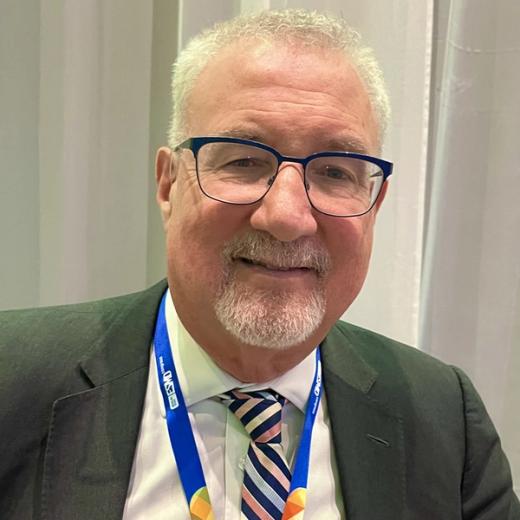
John P. Crown MD MBA: ESMO 2025, Berlin: Adjuvant Ribociclib Brought Longer Freedom from Metastases for Patients with HR+/HER2- Early Breast Cancer: NATALEE Five Year Outcomes
An interview with: John P. Crown MD MBA, Consultant Medical Oncologist, St. Vincent’s University Hospital, Dublin, Professor of Translational Cancer Research, Dublin City University, Professor of Medicine, University College Dublin Ireland.
BERLIN, Germany—Patients with high-risk node-negative ER-positive HER2-negative early breast cancer who had the CDK 4/6 inhibitor drug ribociclib added to their non-steroidal aromatase inhibitor (AI) adjuvant therapy after surgery had significantly longer freedom from progression to invasive disease compared with patients receiving the AI alone. This is according to five-year data from the NATALEE trial reported at the 2025 Annual Congress of the European Society for Medical Oncology.
Professor John P. Crown MD MBA, Consultant Medical Oncologist, from St. Vincent’s University Hospital in Dublin gave reporter Peter Goodwin the latest details:
Audio Journal of Oncology, John P. Crown MD MBA,
IN: “[GOODWIN] I am at the ESMO meeting, 2025, in Berlin ….OUT: signing off for the Audio Journal of Oncology.” 11:24 secs
2025 ESMO: Proffered Paper Friday 14:00 Oct 17, 2025
Abstract Title:
LBA14 – Adjuvant ribociclib (RIB) plus nonsteroidal aromatase inhibitor (NSAI) in patients (pts) with HR+/HER2− early breast cancer (EBC): NATALEE 5-year outcomes
Speaker:
John P. Crown (Dublin, Ireland)
Authors:
John P. Crown (Dublin, Ireland) Daniil Stroyakovskiy (Moscow, Russian Federation) Denise Yardley (Chattanooga, United States of America) Chiun-Sheng Huang (Taipei City, Taiwan) Peter A. Fasching (Erlangen, Germany) Aditya Bardia (Los Angeles, United States of America) Stephen Chia (Vancouver, Canada) Seock-Ah Im (Seoul, Republic of Korea) Miguel Martin (Madrid, Spain) Binghe Xu (Beijing, China) Carlos H. Barrios (Porto Alegre, Brazil) Michael Untch (Berlin, Germany) Rebecca Moroose (Lake Mary, United States of America) Sara A. Hurvitz (Seattle, United States of America, CA) Gabriel N. Hortobagyi (Houston, United States of America) Dennis Slamon (Los Angeles, United States of America) Frances Visco (Washington, United States of America) Gonzalo Spera (Montevideo, Uruguay) Zheng Li (East Hanover, United States of America) Sherene Loi (Melbourne, Australia, VIC)
Background:
The phase 3 NATALEE trial demonstrated that adjuvant RIB + NSAI led to a statistically significant invasive disease–free survival (iDFS) benefit in pts with stage II and III HR+/HER2− EBC. We present a protocol-specified 5-year efficacy analysis.
Methods:
Pts with HR+/HER2− EBC were randomized 1:1 to RIB (400 mg/d; 3 weeks on/1 week off for 3 y) + NSAI (letrozole 2.5 mg/d or anastrozole 1 mg/d for 5 y) or NSAI alone. Men and premenopausal women received goserelin. Pts were included if they had anatomical stage IIA (if N1 [1-3 axillary lymph nodes] or N0 with additional high-risk factors), stage IIB, or stage III disease per AJCC, 8th ed. The primary end point of iDFS and secondary efficacy end points of distant disease–free survival (DDFS), distant relapse–free survival (DRFS), and overall survival (OS) were evaluated using Kaplan-Meier methods. Statistical comparisons were made by stratified log-rank test.
Results:
At data cutoff (May 28, 2025), all pts were off RIB treatment, and a similar proportion had completed 5 years of NSAI treatment in both arms (RIB + NSAI, 36.5%; NSAI alone, 34.4%). With a median iDFS follow-up of 55.4 months, RIB + NSAI demonstrated persistent iDFS benefit over NSAI alone (hazard ratio [HR], 0.716; 95% CI: 0.618-0.829; nominal 1-sided P<.0001). Absolute iDFS rates were 90.8% vs 88.0% at 3 y, 88.3% vs 83.9% at 4 y, and 85.5% vs 81.0% at 5 y (absolute improvement of 2.7%, 4.4%, and 4.5%, respectively). iDFS benefit was observed across subgroups, including N0 (HR, 0.606; 95% CI: 0.372-0.986). RIB + NSAI also demonstrated continued DDFS (HR, 0.709; 95% CI: 0.608-0.827) and DRFS (HR, 0.699; 95% CI: 0.594-0.824) benefit vs NSAI alone. A positive trend for OS favoring RIB + NSAI (HR, 0.800; 95% CI: 0.637-1.003; nominal 1-sided P=.026) continues to emerge. No new safety signals were observed with a median follow-up time of approximately 2 years after RIB completion.
Conclusions:
In this 5-year landmark analysis with mature efficacy data, RIB + NSAI reduced the risk of invasive and distant disease recurrence compared with NSAI alone, including in pts with high-risk N0 disease. A positive trend for OS in favor of RIB + NSAI continues to emerge.
Tags
Related Episodes

Paul H Cottu MD PhD, ESMO Berlin: Chemo-Free Regimen with Neoadjuvant CDK 4/6 Inhibition plus Endocrine Therapy Benefits Patients with High-Risk ER+ HER2- Early Breast Cancer
Aan identifyable subset of patients with high-risk ER+ HER2- early breast cancer better off without chemotherapy

ESMO 2025; Christof Vulsteke MD PhD: Perioperative Enfortumab Vedotin Therapy With Pembrolizumab Boosts Event-Free and Overall Survival in Platinum-Ineligible Patients with Muscle-Invasive Bladder Cancer: KEYNOTE-905 study
A big step forwards in the management of muscle invasive bladder cancer in which platinum cannot be used has been taken in the KEYNOTE-905 study of perioperative antibody drug conjugate thereapy with

Martin Wermke MD; ESMO 2025: Initial Therapy with Bi-Specific T-cell Engager Tarlatamab Promises Better Outcomes in Patients with Small Cell Lung Cancer
Tarlatamab, a bi-specific T-cell engager drug added to innitial immunochemotherapy brought encouraging initial survival outcomes in the DeLLphi-303 reported at the European Society for Medical Oncolog