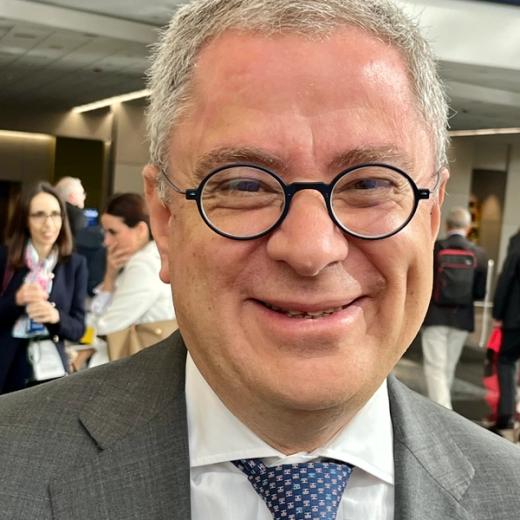
Ghassan K. Abou-Alfa MD PhD; ASCO 2026: Adding Doublet Immune Checkpoint Inhibition to Embolization with or without anti-Growth Factor TKI Therapy Extends Progression Free Survival in Patients with Hepatocellular Cancer
CHICAGO, USA—Patients with unresectable liver cancers who were eligible for treatment with transarterial chemoembolization (TACE), were randomly offered, treatment with the anti-CTL-4 checkpoint inhibitor tremelimumab together with the anti PD-L1 inhibitor durvalumab with or without a third drug: the multiple VEGFR 1, 2 & 3 kinase inhibitor, lenvatinib, in the phase threeEMERALD-3 study. Findings of a significant improvement of progression free survival were reported at the 2026 American Society of Clinical Oncology Annual Meeting by first author Ghassan Abou-Alfa MD PhD from the Gastrointestinal Oncology Service at Memorial Sloan Kettering Cancer Center, in New York and Weill Medical College, Cornell University, New York, NY. After his talk in Chicago Dr. Abou-Alfa gave Peter Goodwin the details:
Ghassan K. Abou-Alfa: 2026 ASCO Audio Journal of Oncology
June 30, 2026
Adding Doublet Immune Checkpoint Inhibition to Embolization with or without anti-Growth Factor TKI Therapy Extends Progression Free Survival in Patients with Hepatocellular Cancer
An interview with Ghassan K. Abou-Alfa MD PhD, Medical Oncologist, Gastrointestinal Oncology Service, Memorial Sloan Kettering Cancer Center, New York; Weill Medical College, Cornell University, New York, USA
CHICAGO, USA—Patients with unresectable liver cancers who were eligible for treatment with transarterial chemoembolization (TACE), were randomly offered, treatment with the anti-CTL-4checkpoint inhibitor tremelimumab together with the anti PD-L1 inhibitor durvalumab with or without a third drug: the multiple VEGFR 1, 2 & 3 kinase inhibitor, lenvatinib, in the phase threeEMERALD-3 study.
Findings of a significant improvement of progression free survival were reported at the 2026 American Society of Clinical Oncology Annual Meeting by first author Ghassan Abou-Alfa MD PhD from the Gastrointestinal Oncology Service at Memorial Sloan Kettering Cancer Center, in New York and Weill Medical College, Cornell University, New York, NY. After his talk in Chicago Dr. Abou-Alfa gave Peter Goodwin the details:
AUDIO JOURNAL OF ONCOLOGY Ghassan K. Abou-Alfa MD PhD
IN: [GOODWIN] Peter Goodwin here at the American…….
OUT: ………of Oncology, I’m Peter Goodwin8:59secs
ASCO 2026 ABSTRACT LBA 4000
Efficacy and safety results from EMERALD-3: A phase 3, randomized study of tremelimumab plus durvalumab with or without lenvatinib combined with transarterial chemoembolization (TACE) in participants (pts) with unresectable embolization-eligible hepatocellular carcinoma (eeHCC).
First Author: Ghassan Abou-Alfa, MD, PhD, MBA, JD, FASCO
Memorial Sloan Kettering Cancer Center; Weill Medical College at Cornell University, New York, NY
Background:
TACE, a global standard of care (SoC) for unresectable eeHCC, induces a tumor immune response. STRIDE (Single Tremelimumab [T] Regular Interval Durvalumab [D]) has shown OS benefit at 6-year follow-up and is a SoC for unresectable advanced HCC. We report preplanned analyses from EMERALD 3 (NCT05301842), which combined STRIDE ± lenvatinib (L) with TACE.
Methods:
Eligible pts (≥18 yr) with confirmed eeHCC were randomized 1:1:1 to STRIDE (T 300 mg + D 1500 mg on Day 1 then D 1500 mg Q4W) + L (8 or 12 mg QD) + TACE; STRIDE + TACE; or TACE until reaching 175 pts/arm. Randomization continued 1:1 until STRIDE + L + TACE and TACE reached 275 pts/arm. D and L continued for ≤36 months (mo), until disease progression, unacceptable toxicity, or withdrawn consent. Pts were stratified by region, any prior palliative embolization, and baseline tumor burden by the Up To-Seven criteria. The primary endpoint was PFS for STRIDE + L + TACE vs TACE by a stratified Cox proportional hazards model and stratified log-rank test. Key secondary endpoints were OS (STRIDE + L + TACE vs TACE), and PFS plus OS (STRIDE + TACE vs TACE).
Results:
As of Feb 23, 2026, 293 pts were randomized to STRIDE + L + TACE, 175 to STRIDE + TACE, and 292 to TACE. Baseline characteristics were broadly balanced across arms. STRIDE + L + TACE showed a statistically significant improvement in PFS vs TACE (HR, 0.70; 95% CI, 0.57–0.86; p=0.0007), and a positive OS trend (HR, 0.84; 95% CI, 0.65–1.09; p=0.1814). STRIDE + TACE also improved PFS (HR, 0.71; 95% CI, 0.56–0.91) and OS (HR, 0.70; 95% CI, 0.51–0.95) vs TACE. STRIDE ± L + TACE showed higher 24-mo OS rate vs TACE (Table). The incidence of treatment-related AEs of maximum grade 3/4 was 62.7% for STRIDE + L + TACE, 48.6% for STRIDE + TACE, and 18.6% for TACE.
Conclusions:
STRIDE + L + TACE significantly improved PFS vs TACE. At interim analysis, with ≤45% maturity, a positive trend for OS with STRIDE ± L + TACE vs TACE was observed. STRIDE + TACE also improved PFS vs TACE. AEs were aligned with known safety profiles of individual therapies. The EMERALD-3 results support STRIDE ± L + TACE as potential new treatment option in unresectable eeHCC.
First Author: Ghassan Abou-Alfa, MD, PhD, MBA, JD, FASCO
References
- Efficacy and safety results from EMERALD-3: A phase 3, randomized study of tremelimumab plus durvalumab with or without lenvatinib combined with transarterial chemoembolization (TACE) in participants (pts) with unresectable embolization-eligible hepatocellular carcinoma (eeHCC).