ASH 2025
Interviews and expert commentary from ASH 2025 — study authors and key opinion leaders discuss the findings and their clinical implications.
Othman Al-Sawaf MD PhD; ASH 2025: Fixed-Duration Targeted Combinations As Effective as Extended Monotherapy for Patients with Untreated Chronic Lymphocytic Leukemia
Othman Al-Sawaf MD PhD, a hematologist from University Hospital of Cologne, presents early data from the CLL17 international phase three trial at ASH 2025. The findings indicate that fixed-duration treatment with venetoclax plus obinutuzumab or venetoclax plus ibrutinib is non-inferior to continuous ibrutinib for patients with previously untreated chronic lymphocytic leukemia, potentially becoming the preferred treatment.
Juan Du MD PhD, ASH 2025: Dual Targeted FasTCAR-T Therapy brings Deep, Durable Responses to Patients with Newly Diagnosed Multiple Myeloma
Dr. Juan Du presented early phase one study findings at ASH 2025, detailing a novel dual-targeted FasTCAR-T therapy for newly diagnosed multiple myeloma. The study demonstrated deep, durable responses in patients using the BCMA and CD19-targeting CAR T-cell platform, GC012F/AZD0120. These promising results, consistent across all dose groups, highlight a highly favorable safety profile and potential for patients, including those with high-risk features and transplant-ineligible individuals.
María-Victoria Mateos; ASH 2025: Unprecedented Survival Benefits with BCMA/CD3 Bispecific Antibody Teclistamab in Patients with Relapsed or Refractory Multiple Myeloma: Majestec-3 Study Findings
This podcast episode, recorded at ASH 2025, features an interview with María-Victoria Mateos MD PhD, who discusses groundbreaking findings from the Majestec-3 study. The study highlights unprecedented survival benefits with the BCMA/CD3 bispecific antibody teclistamab. In patients with relapsed or refractory multiple myeloma, adding teclistamab to standard second-line therapies significantly improved progression-free and overall survival.
Wojciech Jurczak MD PhD; ASH 2025: Big Study Suggests Non-Covalent BTK Inhibitor Pirtobrutinib Could be New Standard-of-Care for Patients with Untreated Chronic Lymphocytic Leukemia
Wojciech Jurczak MD PhD discusses research from ASH 2025, revealing that the non-covalent BTK inhibitor pirtobrutinib is superior to bendamustine plus rituximab as initial therapy for untreated chronic lymphocytic leukemia and small lymphocytic lymphoma. The BRUIN CLL-313 phase 3 study found pirtobrutinib significantly improved progression-free survival and was well-tolerated. These data suggest pirtobrutinib could become a new standard of care for these patients.
Lorenzo Falchi MD; ASH 2025: Bispecific Antibody Epcoritamab Combination Beats Standard of Care for Patients with Relapsed/Refractory Follicular Lymphoma
This episode discusses how the bispecific antibody Epcoritamab, in combination with rituximab and lenalidomide, has outperformed standard treatment for relapsed/refractory follicular lymphoma in the phase three epcore FL-1 trial. Dr. Lorenzo Falchi, an attending physician at Memorial Sloan Kettering, was interviewed at the ASH 2025 Annual Meeting, where these significant findings, including improved ORR and PFS, were presented, demonstrating a substantial reduction in the risk of progression or
Amir Fathi MD; ASH 2025: Paradigm Study Finds Young, Fit Adults with Acute Myeloid Leukemia Do Better with Gentler Azacitidine/Venetoclax Initial Therapy
An interview with Amir Fathi MD from Massachusetts General Hospital discusses the Paradigm study presented at ASH 2025. The phase two randomized trial found that young, fit adults with acute myeloid leukemia had improved event-free survival and higher response rates with azacitidine/venetoclax initial therapy. This gentler treatment also led to fewer toxicities and better quality of life compared to standard induction chemotherapy.

Meletios Dimopoulos; ASH 2025: B-Cell Maturation Antigen Bispecific Antibody Linvoseltamab Brings High Response Rates in Patients with Relapsed/Refractory Multiple Myeloma
Meletios Dimopoulos MD, Chair of Clinical Therapeutics at the University of Athens, discusses early findings from the phase 1b LINKER-MM2 trial presented at ASH 2025. The study reveals high clinical response rates for the B-Cell Maturation Antigen bispecific antibody linvoseltamab when combined with anti-CD38 therapy in patients with relapsed/refractory multiple myeloma. These preliminary safety and efficacy data support further development of this promising combination for MM treatment.
Antonio Jimenez Jimenez MD MS; ASH 2025: Donor Choice No Longer a Barrier to Allogeneic Stem Cell Transplantation for Patients with Hematologic Malignancies
Antonio Jimenez Jimenez MD MS, from the University of Miami, presented findings at ASH 2025 indicating that donor choice is less of a barrier to allogeneic stem cell transplantation for patients with hematologic malignancies. The National Marrow Donor Program Access Trial found that post-transplant cyclophosphamide enables a wider, more ethnically diverse range of patients to safely receive transplants from unrelated donors.
Luciano Costa, MD PhD; ASH 2025: CAR T Cell Brings Profound Benefit with Long-Term Progression-Free Survival in Patients with Standard-Risk Relapsed/Refractory Multiple Myeloma
Dr. Luciano Costa discusses the findings from the CARTITUDE-4 study at the ASH 2025 Annual Meeting in Orlando. The study demonstrates that ciltacabtagene autoleucel CAR-T cell therapy provides significant long-term progression-free survival for patients with standard-risk relapsed or refractory multiple myeloma, even as early as second-line treatment. The findings suggest profound benefits in this patient population.
Jesse Tettero MD PhD; ASH 2025: Measurable Residual Disease Can Predict Overall Survival in Patients with Acute Myeloid Leukemia
Dr. Jesse Tettero discusses findings from the HARMONY Alliance study, presented at ASH 2025, validating measurable residual disease (MRD) as a robust predictor of overall survival in acute myeloid leukemia (AML) patients. The study supports MRD's potential as a regulatory surrogate endpoint, particularly MFC-MRD in non-transplanted patients, to accelerate drug development. This large pooled analysis provides critical evidence for future AML drug approvals.
Hisham Abdel-Azim MD MS; ASH 2025: Next Generation Sequencing-Assessed Minimum Residual Disease Identifies Young Patients with High-risk/Relapsed B-cell Acute Lymphoblastic Lymphomas Who Can Omit Pre-Transplant Total Body Irradiation
Dr. Hisham Abdel-Azim discusses findings from the phase two EndRAD trial, presented at ASH 2025. The study reveals that Next Generation Sequencing-Assessed Minimum Residual Disease (NGS-MRD) can identify young patients with high-risk/relapsed B-cell Acute Lymphoblastic Lymphomas (B-ALL) who can safely omit pre-transplant Total Body Irradiation (TBI). This approach achieved comparable survival outcomes while potentially reducing TBI-associated late effects.
Daniel J Zheng MD, MHS, MSHP; ASH 2025 Orlando: Childhood Leukemia Cured But Families Broke! “Financial Toxicity” is Often More Worrying than your Child’s Cancer
Financial Disaster from curative treatment for childhood ALL
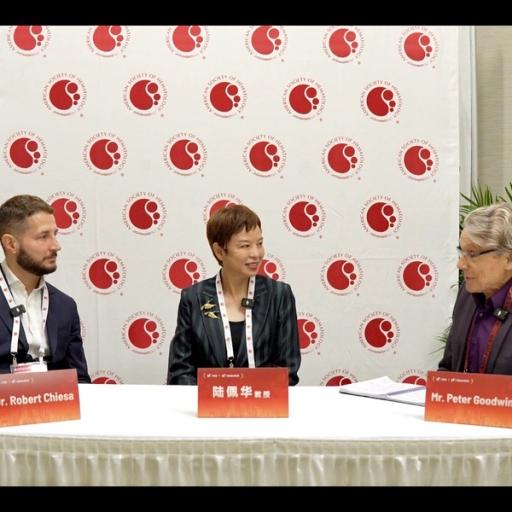
Peihua Lu MD and Robert Chiesa MD PhD; ASH 2025, Orlando: Dramatic Remissions with “Off-the-Shelf” and “Base Edited” CAR T-cell Therapies in Children with Relapsed/Refractory T-Cell Malignancies
Dramatic Cures for Children with No Prospects Using Standard Therapies for T-cell malignancies